
The Foreign Earned Income Exclusion (FEIE) is a provision that allows U.S. taxpayers to exclude a portion of their foreign-earned income from U.S. federal taxation. The rise of remote work and digital nomadism has made FEIE an increasingly common tax strategy for Americans living abroad.
In this guide, we’ll explore how the FEIE works in practice, how to qualify, what’s changed for 2026, and how to use FEIE alongside other expat tax tools.
Table of Contents
- What is the Foreign Earned Income Exclusion?
- How Do You Qualify for the FEIE?
- How to Claim the FEIE Using Form 2555
- Common Mistakes When Applying for the FEIE
- What is the Foreign Tax Credit (FTC)?
- What is the Foreign Housing Exclusion?
- How the FEIE and Foreign Living Work in Practice
- Financial and Lifestyle Considerations of Living Abroad
- The Importance of Professional Tax Advice for Expats
- FAQs About the FEIE
What is the Foreign Earned Income Exclusion?
The Foreign Earned Income Exclusion allows qualifying U.S. taxpayers to exclude a set amount of foreign-earned income from U.S. federal income tax. For the 2026 tax year, the maximum FEIE is $132,900 per qualifying taxpayer — up from $130,000 in 2025. BrightTax notes that the IRS adjusts the exclusion annually for inflation under IRC Section 911.
For many expatriates and remote workers, the FEIE can mean considerable tax savings. Without it, foreign-earned income could be subject to double taxation — taxed both by the country where the work is performed and by the United States.
FEIE works by excluding foreign-earned income up to the applicable limit. For example, if a taxpayer’s foreign-earned income is $160,000 in 2026, they would only be subject to U.S. tax on the $27,100 that exceeds the $132,900 exclusion — and may be able to reduce that further using the Foreign Tax Credit or Foreign Housing Exclusion.
Married couples where both spouses qualify separately can each claim up to $132,900 for 2026, for a combined maximum exclusion of $265,800, according to the Internal Revenue Service.
Recent exclusion amounts for reference:
| Tax Year | FEIE Limit (per person) |
|---|---|
| 2022 | $112,000 |
| 2023 | $120,000 |
| 2024 | $126,500 |
| 2025 | $130,000 |
| 2026 | $132,900 |
The FEIE applies only to foreign earned income. Foreign passive income is not eligible for exclusion. Earned income refers to wages, salaries, bonuses, and self-employment earnings — income obtained through work performed abroad. Passive income such as interest, dividends, rental income, and capital gains does not qualify.
One important note for self-employed expats: the FEIE reduces U.S. income tax but does not reduce self-employment tax. Self-employed Americans abroad still owe 15.3% SE tax on net self-employment income up to the Social Security wage base. Taxes for Expats flags this as a commonly overlooked limitation that can significantly affect freelancers and consultants working abroad.
How Do You Qualify for the FEIE?
To qualify for the FEIE, you must meet specific eligibility requirements. There are two primary tests: the Physical Presence Test and the Bona Fide Residence Test.
The Physical Presence Test
The Physical Presence Test requires:
- The U.S. taxpayer must spend at least 330 full days outside the U.S. within any consecutive 12-month period.
- The U.S. taxpayer must have foreign-earned income.
- The U.S. taxpayer must have a tax home in a foreign country (defined as the primary location where the individual is engaged in work).
A “full day” means a 24-hour calendar day spent entirely outside the U.S. Partial travel days generally do not count. Importantly, the 12-month period does not need to align with the calendar year — it can start on any date, which is helpful for expats who moved abroad mid-year.
Keeping accurate travel records is essential and can be challenging for individuals who travel frequently. Using travel tracking apps or spreadsheets to log daily locations — including departure and arrival dates and flight numbers — is strongly recommended, as the IRS may request this documentation in an audit.
The Bona Fide Residence Test
The Bona Fide Residence Test requires:
- The U.S. taxpayer must have foreign-earned income.
- The U.S. taxpayer must have a tax home in a foreign country.
- The U.S. taxpayer must have been a bona fide resident of a foreign country for at least one full tax year (January 1 through December 31).
“Bona fide resident” status requires demonstrating permanent foreign living with no imminent return to the U.S. Key indicators include long-term housing (leased or owned), local bank accounts, obtaining a residency visa, and strong community ties abroad. Note that if you claim non-resident status for local tax purposes in your host country, you generally cannot claim bona fide residence for FEIE purposes.
Green card holders should be aware that claiming the FEIE could be interpreted by immigration authorities as an intent to abandon permanent U.S. residency, since the exclusion requires establishing a primary residence abroad. This is an immigration consideration — not a tax issue — but worth discussing with both a tax professional and an immigration attorney.
How to Decide Which Test to Use
The Physical Presence Test is generally preferable for individuals working abroad temporarily (for at least 330 full days) or for digital nomads who move between countries. The Bona Fide Residence Test is best suited to individuals intending to live abroad permanently or on an open-ended basis.
The right choice depends on your specific circumstances, and it’s advisable to speak to a tax professional before making that determination. At Harness, we help individuals and small business owners find tax advisors who are experts in expat and international taxes, as well as other complex matters.
How to Claim the FEIE Using Form 2555
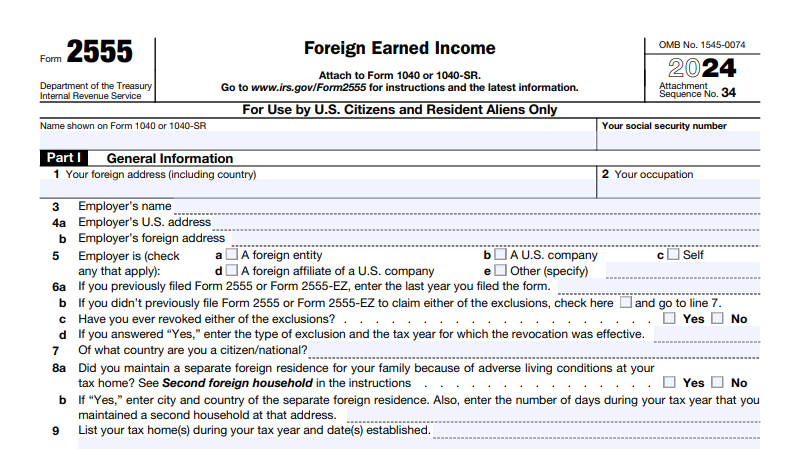
To claim the Foreign Earned Income Exclusion, you file Form 2555 with your Form 1040. For married couples, each spouse files a separate Form 2555, even when filing a joint tax return. Note that the simplified Form 2555-EZ has been retired — all FEIE claims now use the standard Form 2555.
To complete Form 2555, you need to:
- Select between the Bona Fide Residence Test and the Physical Presence Test
- Record all international travel to and from the U.S. during the tax year
- Provide proof of your foreign-earned income
- Calculate the applicable exclusion amount (prorated if you qualified for only part of the year)
How to Fill In Form 2555 — An Example
Using an updated example: Sarah, a software developer, moved to Germany from the United States partway through the 2025 tax year and has lived there throughout 2026.
Step 1 — General Information (Part I): Sarah enters her name, SSN, occupation, and German address.
Step 2 — Bona Fide Residence or Physical Presence Test (Part II or III): Since Sarah has lived in Germany for an entire tax year, she qualifies under the Bona Fide Residence Test and completes Part II.
Step 3 — Reporting Foreign Income (Part IV): Sarah earned €4,500 per month (€54,000 annually). She enters this as her Foreign Earned Income. If her employer provided housing, its value is also included.
Step 4 — Calculating the FEIE (Part VII): For the 2026 tax year, the maximum exclusion is $132,900. Sarah calculates the exchange rate (e.g., 1 EUR = 1.05 USD) and converts her salary (€54,000 × 1.05 = $56,700). Since she lived in Germany all year, she qualifies for 100% of the exclusion period and enters $56,700 as her FEIE — the full amount, since it falls below the $132,900 cap.
Sarah then reports total wages on Form 1040 and enters the FEIE as a negative amount on Schedule 1, Line 8d, reducing her taxable income accordingly.
Situations with multiple income sources, partial-year residency, employer-provided perks, or significant exchange rate fluctuations make this process considerably more complex. Misclassifying income or miscalculating the FEIE can result in audits, lost benefits, or unexpected tax bills. Professional advice is strongly recommended in anything but the simplest cases.
Common Mistakes When Applying for the FEIE
Applying for the FEIE can be a complex process, with mistakes leading to potential tax liabilities, missed benefits, or penalties. Some of the most common errors expats make include:
Assuming you don’t need to file a U.S. tax return: Even if your foreign income is fully excludable, you must still file a U.S. tax return and submit Form 2555 to claim the FEIE. U.S. citizens are taxed on worldwide income regardless of where they live.
Failing to prorate the FEIE: If you move abroad midyear, you cannot claim the full exclusion amount. You must prorate based on your qualifying days abroad. For example, 180 qualifying days in 2026 would yield a maximum exclusion of roughly $65,600 ($132,900 × 180/365).
Revoking the FEIE without understanding the consequences: Once you revoke the FEIE election, you generally cannot claim it again for five years without IRS approval — which requires a Private Letter Ruling.
Choosing the FEIE when the Foreign Tax Credit is better: For expats in high-tax countries, the Foreign Tax Credit may eliminate more U.S. tax liability than the FEIE. The FTC can also apply to passive income that the FEIE cannot cover. And critically, you cannot apply both the FEIE and the FTC to the same dollars of income — strategically allocating between them requires careful planning.
Forgetting that the FEIE doesn’t reduce self-employment tax: As noted above, self-employed expats still owe Social Security and Medicare taxes on excluded income. This is one of the most expensive surprises for freelancers and independent contractors living abroad.
What is the Foreign Tax Credit (FTC)?
The Foreign Tax Credit allows U.S. expats to offset their U.S. tax liability with income taxes paid to foreign governments — on a dollar-for-dollar basis. In high-tax countries, the FTC can often eliminate U.S. tax liability entirely on foreign-sourced income.
Key rules apply:
Eligible taxes: Only income taxes (or taxes paid in lieu of income taxes) paid to foreign governments are eligible. Value-added taxes, property taxes, and most other foreign taxes do not qualify.
Credit limit: The FTC cannot exceed your U.S. tax liability on the relevant foreign income. If the foreign taxes you paid exceed this limit, the excess can generally be carried forward for up to ten years or carried back one year via an amended return.
Stacking with the FEIE: A combination of the FEIE and FTC is often the most effective approach for high earners abroad. For example, if a U.S. taxpayer earns $200,000 abroad in 2026, they can exclude the first $132,900 using the FEIE. The remaining $67,100 may be subject to U.S. tax — but foreign taxes paid on that amount can be credited dollar-for-dollar via the FTC. Any excess FTC not used in the current year can be carried forward.
The key constraint: you cannot apply FTC to income already excluded under the FEIE. Deciding how to allocate income between exclusion and credit requires modeling your specific situation with a tax advisor.
What is the Foreign Housing Exclusion?
The Foreign Housing Exclusion allows U.S. expats to further reduce taxable income by excluding qualifying housing expenses above a base threshold. Eligible expenses include rent, utilities (excluding TV and internet), insurance, property taxes, and furniture rentals.
For 2026, Taxes for Expats calculates the base housing amount at $21,264 (16% of the $132,900 FEIE limit). Only housing costs above this base amount qualify for the exclusion, up to location-specific caps.
2026 maximum housing exclusion limits by city (approximate):
| City | 2026 Limit |
|---|---|
| Hong Kong | $47,380 |
| Geneva | $42,680 |
| London | $38,860 |
| Singapore | $36,900 |
| Tokyo | $36,680 |
| Sydney | $33,280 |
The general standard cap for locations not on the IRS’s high-cost list is $39,870 for 2026. The IRS publishes a complete list of location-specific limits annually.
Expats eligible for the FEIE automatically qualify for the Foreign Housing Exclusion and claim both using Form 2555. Self-employed expats may instead claim the Foreign Housing Deduction, which reduces income available for self-employment tax as well.
How the FEIE and Foreign Living Work in Practice

The FEIE rules are relatively well-defined, but practical implementation involves real-world complexity that the regulations alone don’t capture.
A Tax Advisor’s Personal Experience with FEIE
Neil Johnson, a tax advisor who relocated to Mexico, describes his decision as driven by both professional and personal factors: the FEIE opportunity was meaningful, but so were the lower cost of living and quality of life.
“Not everything is about tax,” says Neil. “It’s also about cost of living. What I’m paying for rent on a three-bedroom, three-and-a-half-bathroom house with a pool in Mexico is what I pay in property taxes in the U.S.”
In preparing for his move, Neil sold his U.S. home to establish intent to live abroad permanently, applied for a Mexican residency visa with his wife to help satisfy the Bona Fide Residence Test, and secured a long-term property lease in Mexico.
Neil’s strategy involves staying abroad for over 330 days per year. “We’ll definitely be outside of that. Even if we come back to the U.S. for doctor’s appointments or business calls, I doubt we’ll spend more than 30 days in the U.S. in any given 12-month period.”
He emphasizes the importance of diligent tracking. “It’s something that people need to be really diligent about.” He also uses a virtual mailbox in Chicago to handle U.S. correspondence — while being careful to make clear to tax authorities that “I’m not conducting any business in Illinois. It’s just a mailing address.”
Lewis Chessis’s Perspective on Tax Compliance Abroad
Lewis Chessis, a Harness tax advisor specializing in U.S. citizens living abroad, highlights one of the most common misconceptions he encounters.
“The reason why U.S. taxation on worldwide income is such a big deal is because many people forget they’re still subject to U.S. tax even after relocating.” The U.S. is one of the very few countries that taxes its citizens based on citizenship rather than residency — meaning even expats with no U.S.-source income must file a U.S. tax return annually.
For expats in high-tax countries, the Foreign Tax Credit provides meaningful relief. “The Foreign Tax Credit allows people working in high-tax countries like the UK to offset their U.S. tax liability by the amount they’ve already paid in taxes abroad,” says Lewis. But expats in low- or no-tax countries face a different challenge. “If you go to a zero-tax jurisdiction, like Singapore, you don’t get the same benefits. In such cases, an expat may owe full U.S. tax on their income, making financial planning even more important.”
FBAR and FATCA
Beyond income tax, expats must comply with foreign asset reporting requirements. U.S. citizens with over $10,000 in foreign financial accounts must file an FBAR (Foreign Bank Account Report). The Foreign Account Tax Compliance Act (FATCA) separately requires foreign financial institutions to report accounts held by U.S. citizens, and U.S. taxpayers with significant foreign assets must file Form 8938. Failing to comply with either requirement can result in severe penalties even if no tax is owed.
For some expats, renouncing U.S. citizenship becomes a consideration as a way to eliminate ongoing U.S. tax obligations. Lewis cautions that this is rarely a simple or obviously right decision. “There’s no set amount of wealth or income where it’s clear that renouncing citizenship is a good idea. U.S. citizens with high net worth may be subject to an exit tax — a final levy on unrealized capital gains — making the process costly.” Long-term consequences including restrictions on future U.S. travel and inheritance tax implications for U.S. family members must also be weighed carefully.
Financial and Lifestyle Considerations of Living Abroad
While the FEIE can offer significant tax benefits, living abroad is not solely a financial decision. Lower living costs can be appealing, but trade-offs exist that aren’t always immediately apparent.
Housing may be more affordable in some countries, but this can mean compromises on infrastructure, safety, access to reliable utilities, or internet quality.
Healthcare costs are often lower abroad, but the quality and availability of care varies widely — rural areas may lack specialized facilities or require substantial travel for treatment. Expats also commonly face hidden costs: visa and residency fees, international banking charges, currency fluctuation exposure, and the administrative burden of navigating unfamiliar legal and bureaucratic systems.
Cultural and lifestyle adjustments — language barriers, different legal frameworks, and unfamiliar daily processes — add complexity that compounds over time. Even straightforward tasks can require more effort than expected when done in a second language or under an unfamiliar regulatory environment.
Careful planning, realistic expectations, and professional guidance help ensure that the financial advantages of the FEIE genuinely align with your broader life goals.
The Importance of Professional Tax Advice for Expats

The FEIE offers significant tax benefits for U.S. citizens living abroad — but managing its complexities requires expertise. A qualified tax advisor can help determine your eligibility, choose the right qualifying test, coordinate the FEIE with the Foreign Tax Credit and Housing Exclusion, and build a tax strategy tailored to your specific income, country, and long-term plans.
At Harness, we can help you find a tax advisor with deep expertise in international and expat taxation.

FAQs About the FEIE
Below are some of the most frequently asked questions about the FEIE and other exclusions.
What is the Foreign Earned Income Exclusion (FEIE)?
The FEIE allows qualifying U.S. taxpayers to exclude up to $132,900 of foreign-earned income from U.S. federal income tax for the 2026 tax year, reducing their U.S. tax liability. The amount is adjusted annually for inflation, per BrightTax.
How do you qualify for the FEIE?
You must meet either the Physical Presence Test (330 full days abroad in any 12-month period) or the Bona Fide Residence Test (established as a bona fide resident of a foreign country for an entire tax year). Both tests also require foreign-earned income and a foreign tax home.
What is the Foreign Tax Credit (FTC)?
The FTC allows U.S. expats to offset their U.S. tax liability by claiming a credit for income taxes paid to foreign governments — on a dollar-for-dollar basis.
Can I combine the FEIE with the FTC?
Yes, and this is often the optimal strategy. The FEIE excludes foreign-earned income up to the annual limit, while the FTC can offset U.S. taxes on income above the exclusion or on passive income the FEIE doesn’t cover. The key rule: you cannot apply both to the same dollar of income.
Does the FEIE reduce self-employment tax?
No. The FEIE reduces U.S. income tax only. Self-employed expats still owe self-employment tax (Social Security and Medicare) on excluded income. Totalization agreements with certain countries may provide relief — consult a tax advisor if this applies to you.
What is the Physical Presence Test?
The Physical Presence Test requires you to be outside the U.S. for at least 330 full days within any consecutive 12-month period. You must also have a foreign tax home and foreign-earned income.
What is the Bona Fide Residence Test?
The Bona Fide Residence Test requires you to establish a primary, permanent residence in a foreign country for an entire tax year. You must demonstrate genuine intent to live abroad — through long-term housing, local financial ties, a residency visa, and other indicators.
What is a tax home?
A tax home is your principal place of business or employment, regardless of where your family resides. Having a tax home in a foreign country is required for both FEIE qualifying tests.
What is FBAR?
The Foreign Bank Account Report (FBAR) is a required filing for U.S. citizens with more than $10,000 in foreign financial accounts at any point during the year. FBAR helps the IRS track offshore assets and prevent tax evasion. Failure to file can result in severe civil and criminal penalties.
What is FATCA?
The Foreign Account Tax Compliance Act (FATCA) requires foreign financial institutions to report accounts held by U.S. citizens to the IRS, and requires U.S. taxpayers with significant foreign assets to file Form 8938. It works in conjunction with FBAR to ensure overseas income and assets are disclosed.
What is Form 2555?
Form 2555 is used to claim the Foreign Earned Income Exclusion and Foreign Housing Exclusion. It must be filed with your Form 1040. The simplified Form 2555-EZ no longer exists — all FEIE claims now use the standard Form 2555.
Can I use the FEIE if I only move abroad temporarily?
Yes, if you meet either qualifying test. The Physical Presence Test is often the more accessible path for temporary assignments or digital nomads, as it doesn’t require establishing permanent foreign residency — only 330 qualifying days outside the U.S. in any 12-month period.
About the experts:

Lewis Chessis, EA, is a tax advisor on the Harness platform and the founder of Chessis Tax. He is a member of the National Association of Enrolled Agents, the Texas Society of Enrolled Agents, and the Texas Society of CPAs. He brings over a decade of experience working for Big 4 firms, advising expatriates and high-net-worth individuals. He is based in Houston, Texas.

Neil Johnson, CPA, is a tax advisor on the Harness platform and the founder of The Tax Dude. He has over thirty years of experience and now specializes in CFO services, equity compensation, cryptocurrency taxation, cannabis taxation and divorce related tax/financial planning matters. He is an expat based in Mexico.
Tax related products and services provided through Harness Tax LLC. Harness Tax LLC is affiliated with Harness Wealth Advisers LLC, collectively referred to as “Harness Wealth”. Harness Wealth Advisers LLC is a paid promoter, internet registered investment adviser. Registration does not imply a certain level of skill or training. This article should not be considered tax or legal advice and is provided for informational purposes only. The information discussed and presented herein is intended to serve as a basis for further discussion with your legal, tax and/or accounting advisors. It is not a substitute for competent advice from these advisors. This article is a product of Harness Tax LLC.
Content should not be regarded as a complete analysis of the subjects discussed. All expressions of opinion reflect the judgment of the author/interviewee as of the date of publication and are subject to change. Material presented is believed to be from reliable sources, however, we make no representations as to its accuracy or completeness. All information and ideas should be discussed in detail with your tax advisor prior to implementation.